
articles/732920705_994042933621618_259260542082821694_n.jpg
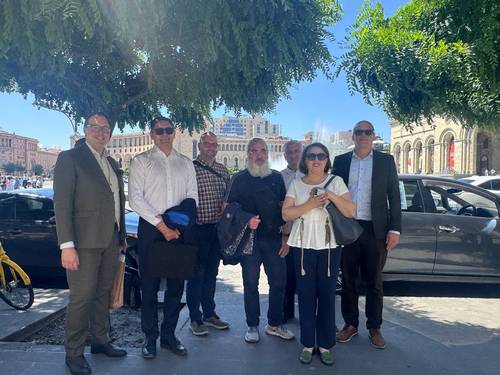
At the end of June, a delegation of Swedish colleagues spent a week in Armenia, travelling from the capital to the country's regions to share their experience in an area they know well: the governance of schools at the local level.
The visit, which took place from 29th of June till 3rd of July, was organised within DeaLoG project's pilot initiative on decentralisation of general education governance. The initiative aims at supporting Armenian municipalities in assuming new responsibilities over schools, while strengthening the governance capacities and institutional capabilities needed to exercise them effectively. Three municipalities and schools have been selected to lead this process: Akhuryan municipality with the secondary school Keti settlement (in Shirak marz), Vayk municipality and Secondary school in Martiros settlement (in Vayots Dzor marz), and Tatev municipality and Secondary school in Tatev settlement (in Syunik marz), The main criteria for selection of pilot municipalities was the fact of subsequent reorganization of relevant schools into educational hubs.
Central to the week was the opportunity of exchange between Swedish and Armenian municipalities around the school governance issues and the application of theSwedish STYRSAM methodology, known as “Governing Together” — an approach successfully applied in 31 municipalities across Sweden. Together with the Maturity Model developed locally by DeaLoG, “Governing Together” is one of the key tools used within the pilot initiative in Armenia either. Rather than a fixed model, it helps communities and schools find practical ways to work together, fostering shared decision-making and a continuous focus on education quality. The delegation included representatives of Västervik, one of the Swedish municipalities where “Governing Together” has been successfully implemented, who came to share the practical experience of applying it.
The week began in Yerevan with meetings at two ministries. At the Ministry of Territorial Administration and Infrastructure, Deputy Minister Mr. Arnak Avetisyan received the delegation, praising Armenian – Swedish cooperation and reviewing the work carried out under DeaLoG project. At the Ministry of Education, Science, Culture and Sport, Deputy Minister Ms. Araksia Svajyan hosted a substantive discussion on the reforms ahead — school management, financing, the distribution of functions, and the capacities communities will need as they take over new responsibilities.
A recurring theme emerged early: decentralisation can succeed only if communities are genuinely equipped for it. It is a challenge Sweden knows well, and one the visit was designed to address through shared, practical experience rather than theory.
Over the following days, the delegation took the discussion into the field, visiting each of the three pilot communities in turn.
In Akhuryan municipality, accompanied by representatives of both ministries, the group met Mayor Mr. Zaven Manukyan, municipal staff and council members and school principals to review the pilot's progress and next steps. The delegation toured a municipal kindergarten and the newly opened Keti educational complex, learning about its infrastructure, governance model and educational opportunities.
In Vayk municipality , Mayor Mkhitar Matevosyan and his team discussed the practical questions and challenges of implementing the pilot, from managing schools to coordinating with the community.
In Tatev municipality , a working meeting brought together Mayor Samvel Lalayan, Deputy Mayor Marat Gerasimyan, council members, municipal staff, school principals and teachers. The Swedish partners presented their own model of school governance — its achievements as well as its obstacles. Mayor Lalayan raised the questions that matter most in a mountainous, sparsely populated region: how Sweden handles school consolidation and closures, how it transports pupils safely from remote settlements, and how it protects jobs through reform. The delegation also visited the Shinuhayr kindergarten and Tatev Secondary School.
Back in Yerevan for the final day, the delegation met the Deputy Mayor Mr. Levon Hovhannisyan and education officials at Yerevan Municipality to discuss education governance in the capital, before the week's concluding event. The meeting was quite important in term of understanding the current practice of delegated governance of schools in Armenia on an example of the Capital (the only municipality, which executes that power).
The week culminated with the “Governing Together” workshop, which drew around 70 participants — representatives of the two ministries, Yerevan Municipality, the pilot communities and schools, and education experts.
Opening the event, Ms. Varsenik Mnatsakanyan, Senior Local Programme Manager and Team Leader of DeaLoG project, described it as an opportunity to exchange experience and learn from Sweden's practices. On behalf of the Ministry of Education, Science, Culture and Sport, Ms. Anush Lalazaryan noted that Armenia has entered an important stage of decentralisation, with the long-term aim of gradually transferring school governance to communities once they are properly equipped.
The Swedish participants then turned to the method itself — outlining how education is governed in Sweden, presenting the philosophy and practical application of “Governing Together,” and sharing Västervik's own experience of putting it into practice, challenges and solutions alike. A dedicated session focused on evidence-based, data-driven decision-making. The workshop then continued with an interactive planning exercise led by the project's education expert, Serob Khachatryan, in which participants mapped roles across the education governance chain and looked together for practical ways to strengthen it at the local level.
By the end of the week, a shared conclusion had taken shape: decentralisation can succeed in Armenia if the responsibility of the future educational complexes is entrusted to communities, and if local governments are given the adequate financial, administrative and human resources to carry it out. Sweden's experience — and Västervik's in particular — offered not a blueprint to copy, but a practical reference point for the road ahead. The work now continues, with the pilot communities and their partners taking the next steps together.